

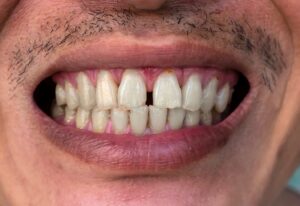
Veneers. They’re maybe the most versatile cosmetic solution when it comes to improving the appearance of your smile. Tooth cracks? Covered. Chipped teeth? Covered. Stained teeth? You guessed it – covered! Gaps between your teeth? Now, that’s an interesting case. In some scenarios, veneers can address the gaps in your smile. However, there are some caveats. We’ll get into all of it below.
How Can Veneers Close a Gap?
Dental veneers are thin shells of tooth-colored material that are bonded to the front surfaces of teeth. Rather than physically moving teeth, veneers can be shaped to alter their size, proportions, and appearance.
For certain small gaps, your dentist may design veneers that slightly widen the visible teeth on either side of the space. When the veneers are placed, they can cover the gap and create the appearance of a more uniform smile.
This approach can produce relatively quick cosmetic results compared with orthodontic treatment, which gradually moves teeth into different positions.
When Might Veneers Be an Option?
Veneers may be considered when the gap is relatively small and the teeth surrounding it are otherwise healthy. They’re particularly focused on changing appearance rather than correcting the underlying position of the teeth.
Your dentist will also evaluate your bite, gums, enamel, and overall oral health before recommending veneers. If you have untreated cavities, gum disease, or other dental problems, those issues may need to be addressed first.
Remember: Veneers Don’t Actually Move Your Teeth
One important distinction is that veneers conceal a gap rather than close it through tooth movement. If your teeth are significantly misaligned, crowded, or affected by a bite problem, orthodontic treatment may be more appropriate.
Moving teeth with braces or clear aligners can address the underlying alignment issue, while veneers primarily change the visible shape and color of the teeth.
What About Veneer Alternatives?
Depending on the size of the gap and your goals, your dentist may discuss other cosmetic options. Dental bonding, for example, can sometimes add tooth-colored material to reshape teeth and reduce the appearance of small spaces. It may require less alteration of natural tooth structure than traditional veneers.
For some patients, clear aligners may provide a more conservative way to move teeth while avoiding traditional braces.
If you’re interested in closing a gap without orthodontic treatment, schedule a consultation with your dentist. They can examine your teeth and determine whether veneers, bonding, orthodontics, or another treatment makes sense for your smile.
About the Author
For more than 20 years, Dr. Shahram Modarres has provided his patients with a satisfying dental experience tailored to their specific needs and goals. He’s a graduate of the New York University School of Dentistry and has attended countless continuing education courses to stay up to date with the latest breakthroughs in the dental field. To learn more about how Dr. Modarres can transform your smile through veneer treatment, visit our website or call our Rockville office at (301) 816-9400.